Overview of AI in FinTech
Artificial Intelligence (AI) is not just a buzzword anymore; it's an influential and dynamic force that is redefining how the financial industry operates. From customer service chatbots to sophisticated fraud detection mechanisms, AI solutions for FinTech are transforming the financial services landscape. The global FinTech industry is expected to reach $305 billion by 2025, and much of this growth is being fueled by AI technologies. The pace of transformation is rapid, driven by the significant advantages AI brings, such as cost reduction, increased accuracy, and enhanced customer experiences. Moreover, the integration of AI into financial systems is streamlining operations, improving compliance, and providing real-time insights into customer needs and market conditions. But what makes AI so crucial to the future of financial services? Let's dive in and explore the major factors behind its growing adoption.
AI offers a powerful toolkit for tackling long-standing challenges in financial services, from risk management to regulatory compliance. Financial institutions have to deal with complex and diverse datasets, and AI’s capacity to parse through this information at lightning speed is changing the game. Besides that, AI allows for predictive analysis, which means financial service providers can anticipate customer needs and market shifts in a way that was previously unimaginable. As we delve into AI's influence on financial services, we also see how it can help bridge the gap between financial accessibility and underserved populations, offering solutions that democratize access to essential services.
Why Financial Services Are Ripe for Innovation
Why is the financial industry so ripe for disruption? Well, financial services have always been data-intensive. Banks, insurance companies, and asset managers handle enormous amounts of information every day, making AI, with its capability to process and analyze large datasets, the perfect fit. Financial institutions have historically been seen as slow to adapt, but the rapid advances in AI have created a competitive necessity for innovation. The demand for real-time financial information, instant customer service, and predictive analysis means that AI is not just an option but a requirement for companies to stay ahead in the game. With increasing customer expectations, financial institutions must leverage AI to deliver personalized and convenient services while ensuring data security and accuracy.
Moreover, there is a strong push from regulators to improve transparency and efficiency, which further fuels the need for AI. Governments and financial watchdogs are encouraging the use of technology to minimize human error and create better monitoring systems. AI offers the tools needed to meet these new regulatory standards while delivering superior services. Whether it’s speeding up loan approvals or customizing product offerings, AI is transforming financial services by introducing agility, precision, and reliability. In today’s fast-paced world, the ability to innovate and evolve quickly is crucial for survival in the financial services sector.
Defining AI Solutions for FinTech
So, what do we mean by AI solutions for FinTech? Essentially, it encompasses technologies like machine learning, natural language processing (NLP), computer vision, robotic process automation (RPA), and even generative AI that are used to solve problems, automate processes, and create better customer experiences in financial services. AI solutions range from personalized financial advice apps to algorithms capable of predicting market trends in real time. These solutions are reshaping the traditional roles in finance by enabling better risk assessment, improved decision-making, and overall enhanced customer satisfaction. The financial landscape is undergoing a massive shift where AI is not only assisting but also actively taking part in crucial decision-making processes that were once solely human-driven.
AI also brings with it the promise of democratizing access to financial services. By automating customer service and providing scalable advisory platforms, AI enables financial institutions to cater to a broader audience without the need for a proportionate increase in resources. This creates new opportunities for underserved populations to engage with financial systems, thereby promoting financial inclusion. Moreover, AI is laying the foundation for financial products that are highly adaptable to individual needs, making the sector more customer-centric and transparent.
The Expansion of AI in FinTech
Historical Perspective of AI in Financial Services
AI has been in financial services longer than most people realize. Automated trading algorithms first appeared on Wall Street back in the 1980s. Fast forward to today, and AI is making financial services more accessible, efficient, and personalized. From early algorithmic trading to the latest generative AI chatbots, the journey has been nothing short of transformational. The evolution has moved from simple automation to intelligent systems that learn and adapt. Now, AI-driven platforms are capable of providing real-time insights, predictive models, and seamless customer interactions that have changed how people perceive financial services. The early days of AI adoption involved risk assessment and fraud detection, but today's AI technologies encompass an array of services, from advisory and support to operational management.
During the early years, AI adoption was confined to the back-end systems of major financial players, focused primarily on reducing manual labor and improving data handling. Today, the narrative has completely changed. AI is now customer-facing, helping clients to manage their wealth, make payments, and receive support in real-time. The breakthroughs in machine learning and computational capabilities have democratized AI applications, bringing them to everyday users. Robo-advisors, personalized banking apps, and AI-powered financial planning tools have made these technologies a part of daily life for millions of people globally.
Key Drivers for AI Adoption in FinTech
Why are financial institutions rushing to adopt AI? One key reason is customer demand. Customers today expect faster, more personalized service—and they aren't willing to wait. Another reason is the operational efficiencies AI provides. AI helps banks save on costs, reduce risks, and streamline everything from fraud detection to customer service. Moreover, regulatory compliance has also become a significant driver, as AI enables better tracking and documentation, reducing the potential for errors. AI-driven predictive analytics offer invaluable insights, allowing companies to anticipate market changes and customer needs proactively. Additionally, AI helps in making complex decision-making processes more streamlined and accurate, ultimately providing a competitive edge to those institutions willing to embrace its potential.
The ever-increasing pressure to adapt to a rapidly changing market is another significant driver. As digital-first FinTech startups gain popularity, traditional financial institutions are forced to innovate or risk becoming obsolete. AI is the catalyst that allows these institutions to remain relevant, keeping pace with the changing landscape. For instance, AI-driven personalization allows traditional banks to provide services that match the customer experience offered by newer, more agile competitors. This dynamic fosters innovation, helping incumbent institutions adapt and stay competitive.
Key Applications of AI in FinTech
Chatbots and Virtual Assistants
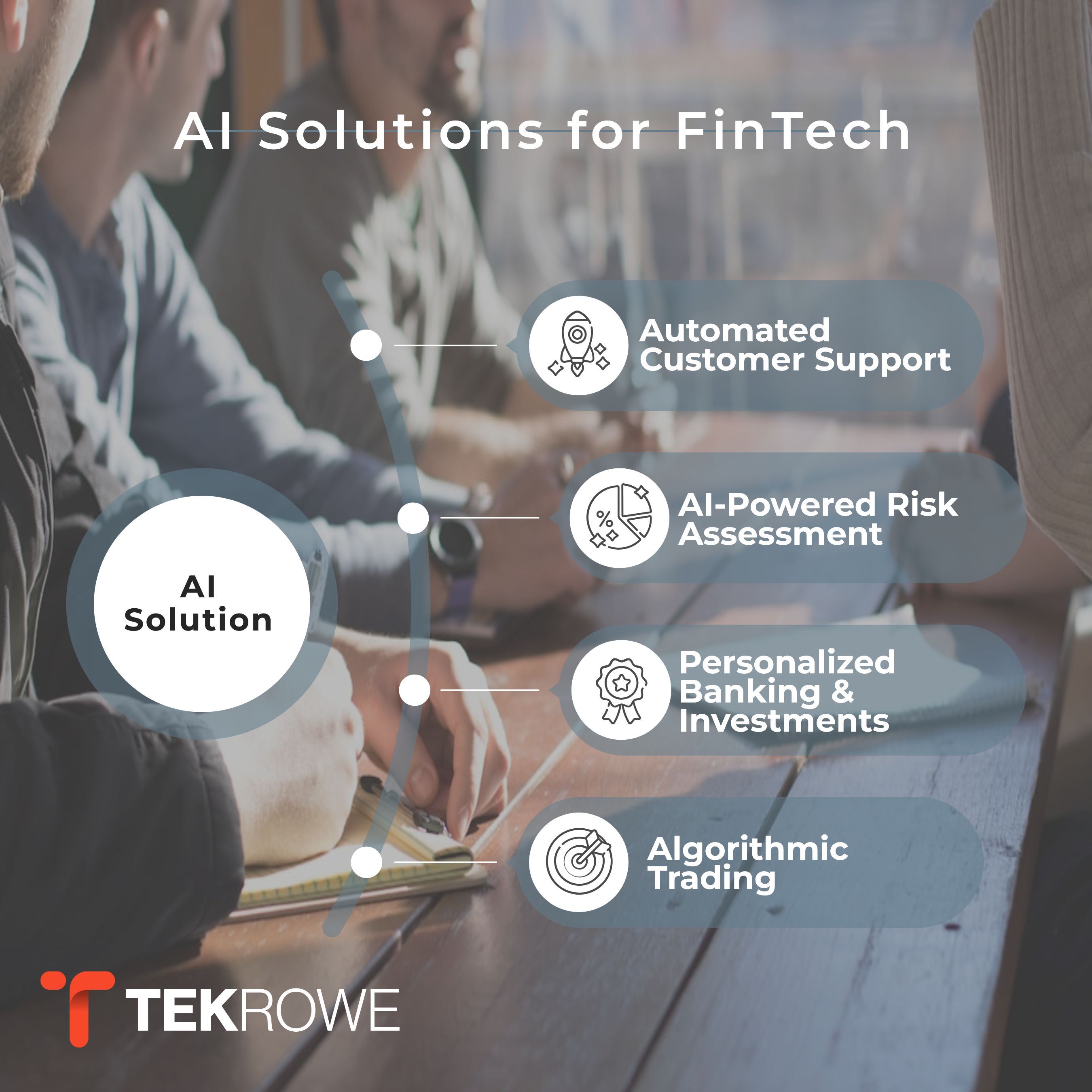
Chatbots are probably one of the most recognizable applications of AI in FinTech. Powered by NLP, these chatbots are helping customers get instant answers to their questions, 24/7. Virtual assistants like Erica from Bank of America or Amex's AI chat are examples of how AI is used to guide users, complete transactions, and answer queries. These bots not only save operational costs but also significantly enhance customer experience by providing quick and efficient support. AI-driven virtual assistants are getting more sophisticated, capable of understanding context and providing even more relevant responses. These chatbots are no longer limited to answering basic queries—they can conduct financial transactions, assist in budgeting, and provide personalized offers based on user behavior. As NLP continues to evolve, virtual assistants are becoming more conversational and capable of handling intricate financial queries, making the user experience smoother and more engaging.
The next wave of chatbot innovation involves integration with more complex banking operations, such as investment guidance, insurance claims, and even tax planning. These intelligent assistants are becoming more empathetic, adapting to the emotional needs of the customer and providing a more human-like interaction. In the near future, the distinction between speaking with a human and an AI assistant will blur, providing an unprecedented level of service quality and reliability. Virtual assistants are also being integrated into mobile banking platforms, providing financial literacy tools and personalized alerts to assist users in managing their finances more effectively.
Fraud Detection and Risk Management
Fraud detection has become increasingly important, especially with more financial transactions happening online. AI solutions use machine learning to analyze user behavior, flagging transactions that seem unusual. This way, fraud detection happens in real-time, preventing losses before they even occur. AI's ability to predict risk is also crucial for financial institutions when it comes to underwriting loans or insurance policies. Using deep learning algorithms, AI systems can evaluate historical data and identify patterns that are often missed by human analysts. This not only improves fraud prevention but also enhances the efficiency of risk management across all sectors of finance. By utilizing AI, financial institutions can proactively safeguard both themselves and their customers, establishing a new level of trust and security that traditional systems could not achieve.
AI is also proving valuable in the area of anti-money laundering (AML). Financial institutions are required to monitor and flag any potentially suspicious transactions, but traditional methods often struggle with the vast number of transactions processed daily. Machine learning models can sift through large datasets to identify anomalies, helping compliance teams quickly pinpoint suspicious activities. This reduces the time and resources needed for AML monitoring, while significantly improving accuracy and reducing false positives. AI’s ability to keep learning and adapting means it can stay ahead of increasingly sophisticated fraudulent tactics, continually bolstering the defenses of financial systems.
Personalized Financial Advice and Wealth Management
AI is transforming wealth management through personalization. Imagine a financial advisor that is available all the time, offering tailored financial advice based on your spending habits, goals, and preferences. Robo-advisors use AI to provide investment advice, balancing portfolios, and recommending actions without human intervention. These solutions are not only cost-effective but also ensure unbiased, data-driven decision-making. AI-driven financial planning tools can track spending, recommend investments, and provide insights on how to save more effectively. Wealth management, which was once exclusive to high-net-worth individuals, is now accessible to anyone with a smartphone, thanks to the capabilities of AI. Moreover, AI provides insights that are not only based on market conditions but also on individual preferences and behaviors, helping users make better-informed decisions regarding their finances.
AI is also changing the way wealth management firms interact with their clients. By offering tailored suggestions and investment options, AI-driven solutions provide clients with a highly customized experience. AI-powered platforms can even predict market downturns and provide insights into risk management strategies, enhancing the client's ability to respond proactively. The integration of AI in wealth management is leveling the playing field, providing a personalized experience that was once only available to clients with substantial portfolios.
Generative AI in FinTech
How Generative AI Is Revolutionizing FinTech
You might have heard of generative AI tools like ChatGPT and how they're disrupting industries—but did you know they're making a splash in FinTech as well? Generative AI can create content, answer customer queries, and even generate predictive models. It opens up new opportunities for creativity in financial services, ranging from custom client solutions to dynamic customer engagements. Generative AI is being used to create personalized communication, financial projections, and even chatbots that can carry on more natural, human-like conversations. The use of generative models has immense potential in providing hyper-personalized marketing and creating sophisticated fraud prevention mechanisms. Additionally, generative AI can assist with internal documentation, creating reports, and synthesizing data in a manner that’s easy to understand and actionable, enhancing operational efficiency in financial institutions.
Generative AI is also gaining traction in automating the customer onboarding process. Traditional onboarding is often a lengthy and document-heavy procedure, but generative AI can simplify this by generating pre-filled forms, crafting personalized onboarding messages, and even creating customized financial product recommendations. By leveraging these AI models, financial institutions can significantly cut down onboarding times and make the initial experience more pleasant for customers. Furthermore, generative AI models can work in tandem with other AI technologies to enhance the overall service landscape, offering a more holistic and integrated experience.
Use Cases of Generative AI in Finance
Generative AI is helping in customer support by answering complex queries, drafting emails, and even generating financial reports. For example, generative AI can help wealth managers prepare customized investment plans based on a client’s financial health, risk appetite, and long-term goals. Another application is in automating regulatory compliance documents, making sure all legal bases are covered without human error. By understanding the intricacies of regulations, generative AI models can draft compliance reports, reducing both time and human effort while maintaining high accuracy. The ability to produce customized communication and dynamic documents has made generative AI a valuable asset in multiple facets of financial operations. Furthermore, AI is enabling the creation of sophisticated analytical tools that generate insights into market trends, empowering financial institutions to make data-backed, timely decisions.
Another promising use case involves the creation of personalized financial plans for clients in real-time. Imagine a customer requesting an overview of their financial health and receiving an instant, detailed, personalized report complete with recommendations for investments, insurance, and even budgeting tips. Generative AI models can create such comprehensive reports by aggregating data from multiple sources and analyzing them to generate coherent, valuable insights. This level of customization and rapid response is something traditional methods would struggle to provide, positioning generative AI as a powerful tool in modern finance.
AI's Role in Enhancing Customer Experience
AI for Personalized Customer Interactions
Imagine being greeted with a perfectly customized message whenever you log into your banking app. AI makes this possible by analyzing customer behavior to craft personalized experiences. By using AI-driven data analysis, financial services can understand customer needs, preferences, and habits, enabling them to tailor solutions uniquely for each user. This level of personalization not only improves customer satisfaction but also builds trust. Banks and other financial institutions are now capable of offering products and services that align perfectly with what customers need, creating a seamless and satisfying experience. As competition intensifies, the ability to provide a deeply personalized service can be a major differentiator for financial institutions seeking to win and retain customers.
AI also allows for hyper-personalized recommendations that adjust in real-time as customer behavior changes. This means that a product or service that is suggested to a customer today might change tomorrow based on new behavioral insights. For instance, if a customer frequently checks mortgage rates, AI can identify this pattern and proactively offer tailored mortgage products or advice. These dynamic responses add immense value to the customer journey and create a sense of loyalty, as customers feel that their bank genuinely understands and anticipates their needs.
Predictive Analytics for Customer Insights
Predictive analytics involves using AI to anticipate customer needs even before they know what they need. Banks are using AI to predict when a customer might need a loan, based on life events such as a wedding or buying a home. This kind of anticipatory service is only possible with the help of sophisticated AI algorithms capable of analyzing patterns over time. The use of predictive models allows financial institutions to act as proactive partners rather than reactive service providers, ultimately creating deeper and more meaningful relationships with their customers. Predictive analytics is also being used for financial health monitoring, where customers receive insights and alerts regarding their spending habits and potential future financial shortfalls, thereby empowering them to take corrective action before issues arise.
Predictive analytics is also valuable for managing customer churn. By identifying signals that a customer may be planning to leave—such as reduced engagement or negative feedback—AI can help institutions intervene before it’s too late. Personalized offers, loyalty programs, or one-on-one consultations can be introduced as preventive measures to retain valuable customers. This use of predictive modeling not only enhances the customer experience but also contributes directly to the business's bottom line by minimizing churn rates.
AI in Financial Operations
Automation of Back Office Tasks
Back-office operations are often overlooked, but they are critical to the smooth functioning of any financial institution. AI is automating these processes, from document verification to data entry, enabling quicker and more efficient workflows. The automation of repetitive tasks reduces human errors and frees up human employees to focus on more value-adding tasks. Beyond the automation of data entry, AI is capable of managing complex workflows involving multiple systems, making the entire back-office operation more agile and responsive to changes. This results in quicker transaction settlements, efficient compliance checks, and ultimately happier customers. Automation through AI also allows for better scalability, enabling financial institutions to handle increased volumes without the proportional increase in costs.
AI-driven automation is also improving the quality of compliance. Traditional methods of compliance involve manual checks and balances, which are time-consuming and prone to errors. AI systems, on the other hand, are capable of conducting thorough checks at high speeds, ensuring adherence to all regulatory norms without fail. This leads to reduced risk of penalties and legal issues while freeing compliance officers to concentrate on more nuanced and strategic aspects of regulation. Financial institutions can thus maintain a high standard of regulatory compliance without compromising on efficiency.
AI-Driven Credit Scoring and Underwriting
Traditional credit scoring methods often leave out people with limited credit histories. AI-driven models are breaking this barrier by taking into account alternative data sources like utility bills, rental payments, and even social media activity. This allows financial services to make more informed and fairer lending decisions, expanding financial access to a broader audience. AI algorithms can analyze thousands of data points that would be impossible for humans to manually assess, ensuring that the creditworthiness of an individual is evaluated in a holistic manner. This innovation has opened the doors for millions of people globally who were previously considered unbankable, thus contributing to financial inclusion. Moreover, the dynamic nature of AI means that credit scores can be updated in real-time, ensuring that they reflect the current financial behavior of individuals more accurately.
AI-powered underwriting models are also evolving, incorporating more granular and real-time data to assess risk more accurately. This is crucial for lenders seeking to extend credit in a way that minimizes risk but also ensures that deserving applicants are not left out. By integrating alternative data, such as employment history and spending patterns, AI provides a comprehensive picture of an applicant’s financial health, far beyond what a traditional credit score could indicate. This is particularly important for underrepresented groups, who may have faced systemic challenges in obtaining credit under conventional underwriting systems.
Need Help with Your Business
Contact Us NowBenefits of AI in Financial Services
Improved Efficiency and Reduced Costs
One of the most significant advantages of using AI in financial services is cost reduction. By automating processes like KYC (Know Your Customer) and compliance checks, institutions can save a lot of money. Moreover, chatbots and robo-advisors are reducing the need for human intervention in customer support, which also brings down costs. AI is also making internal processes more efficient, allowing employees to focus on strategic tasks rather than mundane, repetitive ones. This boosts overall productivity while ensuring higher accuracy in operations. With AI optimizing workflows and automating labor-intensive tasks, financial institutions can maintain profitability while scaling their services to accommodate new markets and customer bases.
Another substantial benefit is the reduction of operational risks. Manual processes are susceptible to human errors that can result in costly mistakes. AI minimizes these risks by ensuring data integrity and accuracy. For example, during the onboarding process, AI systems can automatically verify documents, match information, and flag discrepancies, all in a matter of seconds. These measures drastically reduce the risk of errors and enhance the overall quality of service.
Enhanced Decision Making
AI doesn’t just make things faster; it makes them smarter. Machine learning algorithms analyze massive datasets to offer actionable insights that help in making better decisions. Whether it's deciding on loan approvals or investment opportunities, AI is there to assist in making more informed choices. The speed at which AI can process information means that decisions are not only smarter but are made much quicker, giving financial institutions a competitive edge in the marketplace. AI is also instrumental in portfolio management, helping asset managers optimize their investment strategies by identifying patterns and trends that are invisible to the human eye, thereby providing an enhanced decision-making framework.
AI is also driving decision-making in customer interactions. By analyzing customer data, AI can suggest the next best action, whether it’s recommending a new financial product, adjusting a savings plan, or even suggesting a debt restructuring strategy. These decisions are made based on data-backed insights, ensuring that the outcomes are optimized for both the customer and the financial institution. This dynamic approach not only improves the quality of decisions but also adds a personalized touch to financial services, which is highly valued by today’s consumers.
Challenges in Implementing AI Solutions
Data Privacy Concerns
While AI brings numerous benefits, it also raises privacy concerns. Financial institutions handle sensitive data, and AI systems need access to this data for effective functioning. Balancing the need for data with privacy concerns is one of the biggest challenges facing AI in financial services today. Regulations like GDPR make it crucial for institutions to handle data responsibly, and AI solutions must be designed to prioritize data protection and ensure compliance with evolving regulations. Financial organizations must also educate their customers about data usage to build trust, as transparency in data collection and processing is key to minimizing privacy concerns.
Privacy concerns are also exacerbated by the vast amounts of data AI systems require for training. Ensuring that personal data remains secure while being used to train models is a significant challenge. Techniques like differential privacy, encryption, and anonymization are being used to address these concerns, but they add layers of complexity to AI implementation. Institutions must strike a balance between obtaining the data they need for AI effectiveness and protecting customer privacy.
Regulatory and Compliance Hurdles
The regulatory landscape for AI in finance is still evolving. The use of AI in decision-making processes like lending and underwriting raises questions about fairness and bias. Financial institutions must navigate a complex set of regulations, which can sometimes slow down innovation. To overcome these challenges, many organizations are focusing on "explainable AI," ensuring that AI systems are transparent and their decision-making processes can be easily understood by regulators and stakeholders alike. Compliance teams are also leveraging AI to maintain documentation, ensure policy adherence, and reduce risks related to regulatory audits, thus integrating AI as a support system to navigate compliance requirements.
Moreover, regulatory bodies are beginning to demand proof that AI models are fair and unbiased. This requires significant transparency and explainability in how algorithms function, which can be challenging when dealing with complex neural networks that are often described as "black boxes." To address this, financial institutions are employing methods like model validation, fairness audits, and algorithmic impact assessments to ensure that AI is compliant with regulatory expectations while still delivering effective solutions.
Talent and Skill Gaps
AI is a highly specialized field, and finding the right talent is another major challenge. Financial institutions are competing with tech companies to hire AI specialists, and the demand often far exceeds the supply. There is also a need for upskilling the existing workforce to effectively use AI tools. As AI continues to expand, the gap between available talent and demand will need to be bridged through education and industry collaborations. Partnerships between financial institutions and universities are becoming more common, aiming to cultivate the next generation of AI talent, while internal training programs are focusing on enhancing AI literacy among current employees.
To mitigate this talent gap, many financial institutions are turning to partnerships with FinTech startups that specialize in AI development. By outsourcing specific AI projects or leveraging existing AI-as-a-Service platforms, banks and other institutions can benefit from AI technology without needing to directly employ large teams of data scientists. Moreover, institutions are also investing in retraining initiatives to enable their current workforce to adapt to AI-driven systems, making it easier for non-specialists to leverage AI tools in their daily roles.
Future Trends in AI for FinTech
AI and Blockchain Integration
AI and blockchain are two of the most revolutionary technologies of our time. The integration of these two can lead to more transparent and secure financial transactions. Imagine smart contracts that are both secure and capable of adapting based on real-time data—that’s the future of AI and blockchain in financial services. AI can be used to enhance the efficiency of blockchain by predicting market trends, improving the performance of decentralized applications, and even optimizing transaction throughput in blockchain networks. Blockchain's immutability combined with AI’s analytical power creates a powerful tool for maintaining secure and highly intelligent financial ecosystems.
AI and blockchain integration also opens the door for innovative identity management solutions. Blockchain provides an immutable record of identity, while AI analyzes this information to ensure validity and detect anomalies. This combination offers enhanced security in financial services, reducing fraud and streamlining processes like KYC. Furthermore, the synergy of these technologies could lead to new decentralized finance (DeFi) applications that blend AI-driven analytics with blockchain’s transparency, ultimately changing how financial products are created, traded, and managed.
Ethical AI in Financial Services
The ethical use of AI is becoming increasingly important, especially when dealing with sensitive financial data. Financial institutions are beginning to prioritize transparency and fairness in their AI algorithms, ensuring that AI does not perpetuate biases and that decisions made by AI systems are explainable. Developing ethical AI that respects customer privacy and aligns with societal values is essential for gaining trust and ensuring the widespread acceptance of AI in financial services. This includes creating algorithms that are free from discrimination, conducting regular audits, and being transparent with customers about how their data is used and how AI-driven decisions impact them.
The financial industry is also recognizing the importance of embedding ethical considerations into AI development from the outset. Bias detection tools are being developed to identify and mitigate biases within datasets and algorithms, thus ensuring that outcomes are equitable. Moreover, explainability in AI decision-making is being emphasized to maintain accountability. The aim is to create AI that not only delivers financial benefits but also adheres to the principles of fairness, non-discrimination, and privacy, thereby fostering a responsible AI ecosystem.
AI's Promise in Transforming Financial Services
AI solutions for FinTech are here to stay, and they are transforming financial services in ways we couldn't have imagined even a decade ago. From personalized customer experiences to fraud detection and from generative AI to automation, the impact is profound. As we move forward, it’s clear that those financial institutions willing to embrace AI will be better positioned to serve their customers, improve efficiencies, and drive growth. The key lies in balancing innovation with responsibility—leveraging AI to its fullest potential while keeping data privacy, ethics, and customer trust at the forefront. The future of financial services is digital, and AI is the driver that will help navigate this transformative journey.
As financial services continue to embrace AI, the line between technology and finance will increasingly blur. The opportunities AI presents—ranging from operational efficiencies to customer satisfaction—are immense. However, it's equally important for institutions to address the challenges that come with AI, such as data privacy, skill shortages, and ethical dilemmas. Successfully integrating AI into FinTech is not just about technology; it's about building a new culture of trust, transparency, and collaboration that aligns with modern expectations. Financial institutions that can walk this fine line are poised to shape the future of finance, making it more inclusive, efficient, and responsive to the needs of all stakeholders.